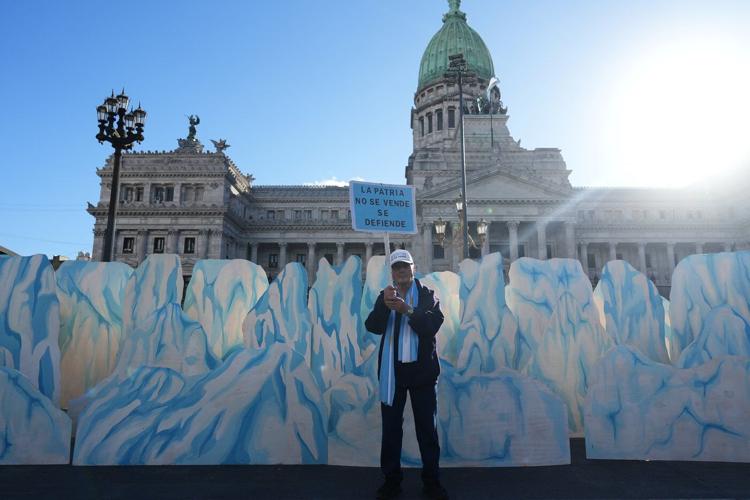
A demonstrator holds a banner that reads in Spanish, "The homeland is not for sale, it's defended" as lawmakers debate the Javier Milei government's proposal to reform the glacier protection law, outside Congress in Buenos Aires, Argentina, Wednesday, April 8, 2026. (AP Photo/Rodrigo Abd)
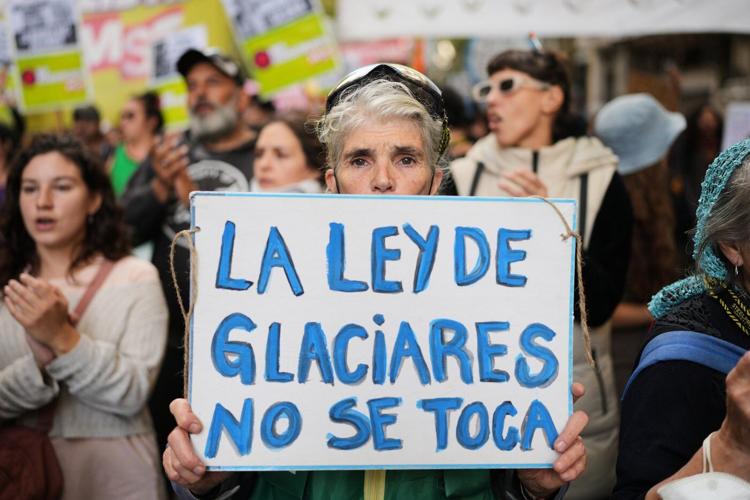
A demonstrator holds a banner that reads in Spanish, "The glacier law must not be touched," as lawmakers debate the Javier Milei government's proposal to reform the glacier protection law, outside Congress in Buenos Aires, Argentina, Wednesday, April 8, 2026. (AP Photo/Rodrigo Abd)
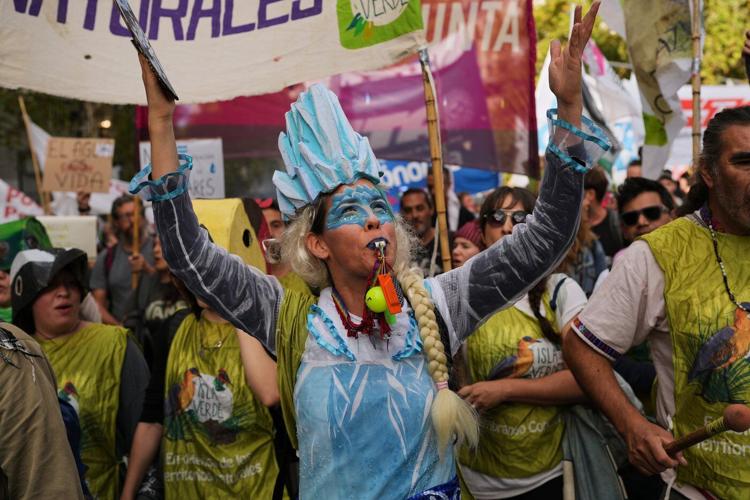
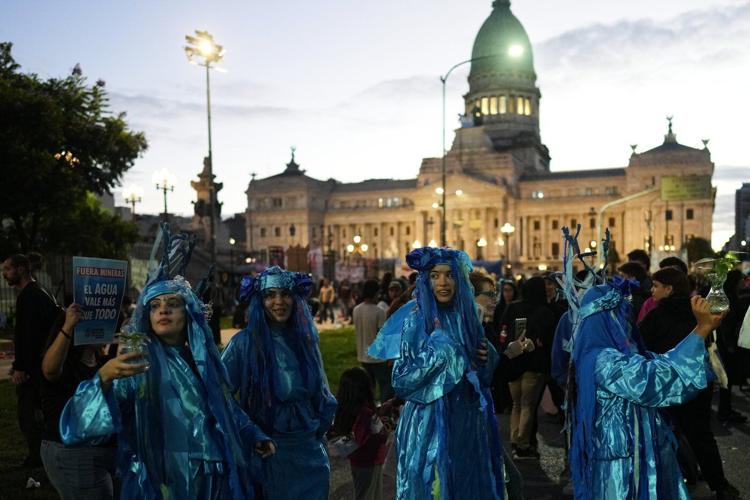
Demonstrators protest outside Congress as lawmakers debate the Javier Milei government's proposal to reform the glacier protection law in Buenos Aires, Argentina, Wednesday, April 8, 2026. (AP Photo/Rodrigo Abd)
Demonstrators protest outside Congress as lawmakers debate the Javier Milei government's proposal to reform the glacier protection law in Buenos Aires, Argentina, Wednesday, April 8, 2026. (AP Photo/Rodrigo Abd)
A demonstrator holds a banner that reads in Spanish, "The homeland is not for sale, it's defended" as lawmakers debate the Javier Milei government's proposal to reform the glacier protection law, outside Congress in Buenos Aires, Argentina, Wednesday, April 8, 2026. (AP Photo/Rodrigo Abd)
NP
A demonstrator holds a banner that reads in Spanish, "The glacier law must not be touched," as lawmakers debate the Javier Milei government's proposal to reform the glacier protection law, outside Congress in Buenos Aires, Argentina, Wednesday, April 8, 2026. (AP Photo/Rodrigo Abd)
NP
Demonstrators protest outside Congress as lawmakers debate the Javier Milei government's proposal to reform the glacier protection law in Buenos Aires, Argentina, Wednesday, April 8, 2026. (AP Photo/Rodrigo Abd)
NP
Demonstrators protest outside Congress as lawmakers debate the Javier Milei government's proposal to reform the glacier protection law in Buenos Aires, Argentina, Wednesday, April 8, 2026. (AP Photo/Rodrigo Abd)
BUENOS AIRES, Argentina (AP) — Argentina's Congress on Thursday approved a controversial bill promoted by libertarian President Javier Milei that eases glacier protections to facilitate investments in mining for metals — a move environmental groups vow to challenge in courts.
The legislation — which was already approved by the Senate in February — was passed in the early morning with 137 votes in favor, 111 against and three abstentions.
According to mining sector estimates, the new regulatory framework could unlock over $30 billion in investments over the next decade. Approximately 70% of those funds are slated for new copper, gold and silver projects.
Milei is expected to sign the legislation in the coming days.
Environmental advocates are shifting to legal action to prevent the new law from taking effect.
Groups including Greenpeace and the Environment and Natural Resources Foundations are organizing a public class-action lawsuit describing the bill’s passage as a flawed process that dismissed public concerns over water safety.
“If they refuse to listen in Congress, they will be forced to listen in the courts,� the organizations said in a statement, urging citizens to join a lawsuit that argues the reform threatens water access and the fragile ecosystems surrounding glaciers.
Opposition lawmakers have labeled the legislation unconstitutional, contending that it rolls back essential environmental protections.
In 2010, Argentina passed a landmark law banning all mining activity on glaciers and within periglacial zones — areas of frozen ground that act as vital water regulators.
The most significant shift in the Milei administration’s reform is a narrowing of these protections. Under the new framework, only glaciers and landforms with “specific hydrological functions� would be shielded, with each province responsible for making that determination.
Argentina is home to 16,968 distributed across the Andes Mountain Range and the South Atlantic Islands, covering a total surface area of 8,484 square kilometers (3,276 square miles).
Glaciology experts have warned that is already causing glaciers to retreat at an accelerated pace. Scientists caution that weakening these protections could jeopardize water security in arid regions and deplete the reserves that sustain river flows.
___
Follow AP’s coverage of Latin America and the Caribbean at