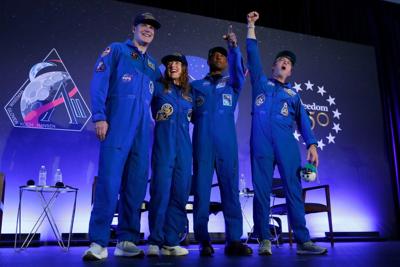
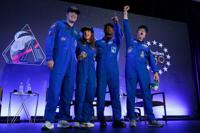
HOUSTON - Canadian astronaut Jeremy Hansen reflected on his historic Artemis II lunar mission on Thursday, saying it left him with a powerful sense of his connection to all of humanity.
"Small and powerless, yet powerful together," Hansen said at a news conference for the Artemis ll crew at the Houston space centre 鈥� the first since the astronauts returned to Earth.
The four-person crew 鈥� commander Reid Wiseman, pilot Victor Glover and mission specialists Christina Koch and Hansen 鈥� splashed down in the Pacific Ocean near San Diego, Calif., on April 10.
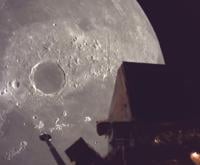
The 10-day flight saw astronauts travel to the moon for the first time in more than 50 years, setting a record for the greatest distance travelled by humans away from Earth.
All four space explorers said they were still grappling with the profound feelings that surfaced while they circled the moon, stared out into the void and glanced back at Earth as their spacecraft moved further and further from its surface.
Reid said it's still "very hard to fully grasp what we just went through."
After their return to Earth, the astronauts underwent initial medical checks aboard the ship that recovered them off the San Diego coast. They were then flown to Houston, where they were greeted with a jubilant homecoming at Ellington Field near NASA鈥檚 Johnson Space Center and Mission Control.
The astronauts were watched around the world and praised for the friendship and love for each other they displayed during the mission. In an emotional moment, the crew asked that a lunar crater be named after Wiseman鈥檚 late wife Carroll, who died of cancer in 2020.
"We launched as friends and we came back as best friends," Reid said.
Nearly a week after their return, the astronauts' connection remained clear. They joked about learning how to crawl around each other in the tight confines of the Orion capsule 鈥� which was named Integrity 鈥� and praised each other's achievements.
The crew said they were just starting to understand just how much the mission captured the world's attention.
"We took your hearts with us and your hearts lifted our hearts," Koch said.
Hansen, 50, of London, Ont., also made history during the mission as the first non-American to travel beyond low Earth orbit. He is also the first person to speak French while en route to the moon.
Hansen and his crewmates spoke with Prime Minister Mark Carney while in space. Carney called the mission "hugely inspiring" and said Canadians couldn't be more proud of Hansen and the collaboration with the United States.
Canada was the first of dozens of nations to join the Artemis program. Hansen and his crewmates on Thursday praised the international efforts involved in advancing human space flight.
"You need the support of others to do big things," Hansen said.
Unlike the Apollo program, which sent men to the moon from 1968 through 1972, the Artemis program is setting the stage for a more permanent human lunar presence and laying the groundwork to send astronauts to Mars.
NASA said the Artemis II crew achieved the mission鈥檚 primary objectives: testing its life support systems; manually piloting the Orion spacecraft; performing manoeuvres to propel Orion to the moon and adjust its course; conducting a lunar flyby with unprecedented views of the moon's far side; and completing a safe re-entry and recovery.
Glover said the spacecraft "flew like a dream."
The mission was not without problems 鈥� the toilet's primary vent line became clogged and a smoke detector went off. Mission officials also anxiously watched the performance of the Orion capsule's life-protecting heat shield, which had issues during the initial unmanned Artemis I mission.
The astronauts said it was important to take all of that information back to NASA in order to solve those problems before the next crew takes flight.
The crew said they were thrilled by the mission's outcome and optimistic about the Artemis program's lofty goals for the future of human space exploration.
When asked for their advice for future Artemis crews, they said crewmates have to invest in each other, ask questions and remember they're part of a team.
This report by 国产诱惑福利 was first published April 16, 2026.
鈥� With files from The Associated Press