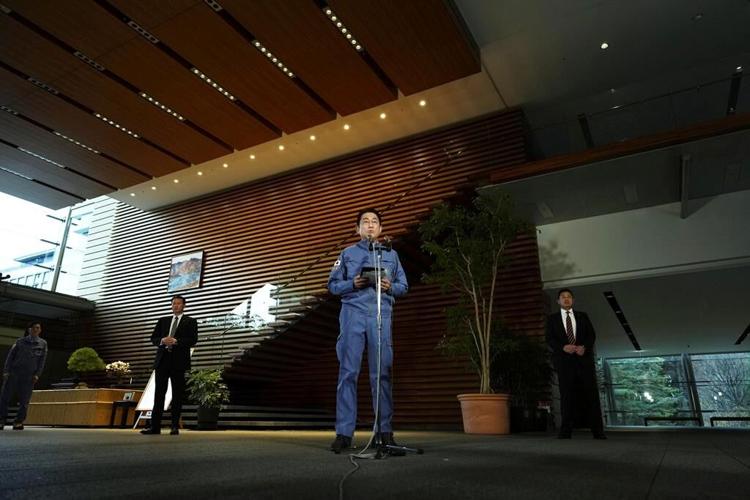
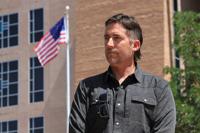
Japanese Prime Minister Fumio Kishida speaks to the media at his official residence in Tokyo, on Sunday, Jan. 7, 2024. Japanese prosecutors made their first arrest Sunday in connection with a major political slush fund scandal that has rocked Prime Minister Kishida's already unpopular government.(Kyodo News via AP)
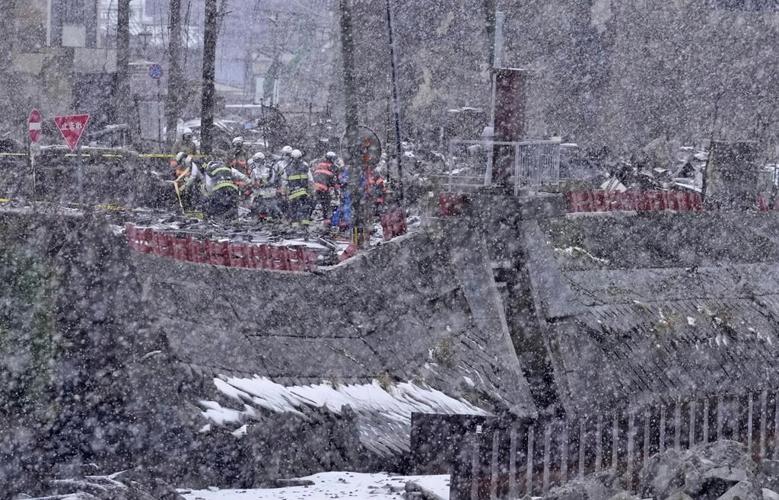
Firefighters search for missing people in the snow in Wajima, Ishikawa prefecture, Sunday, Jan. 7, 2024. Rescue teams worked through snow to deliver supplies to isolated hamlets Monday, a week after a powerful earthquake hit western Japan. (Kyodo News via AP)
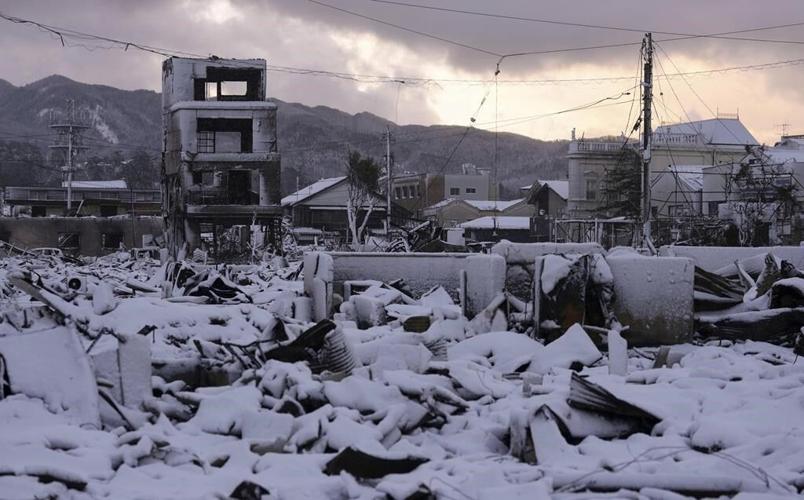
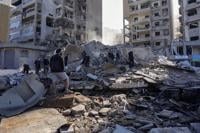
Rubble is snow-covered at a marketplace after a large fire in the earthquake-hit city, Wajima, Ishikawa prefecture, Monday, Jan. 8, 2024. Thousands of people made homeless overnight are living in weariness and uncertainty on the western coast of Japan a week after powerful earthquakes hit the region. (Kyodo News via AP)
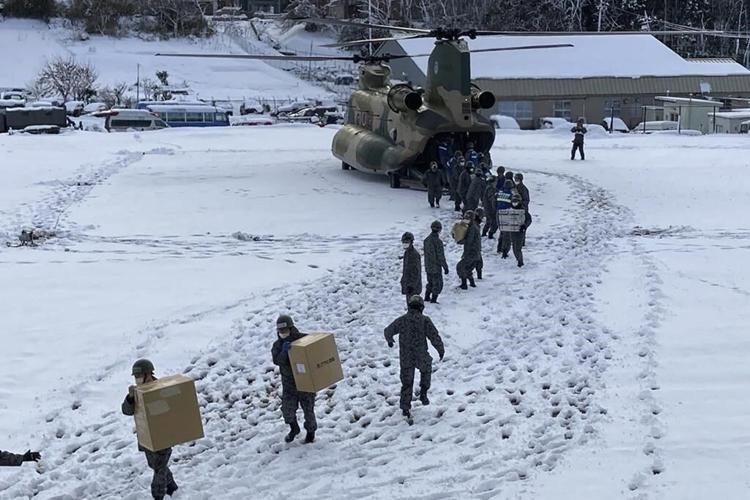
In this photo provided by Japanese Ministry of Defense, members of Japan Self-Defense Forces carry relief goods in the earthquake-hit city Wajima, Ishikawa prefecture, Japan Monday, Jan. 8, 2024. (Japanese Ministry of Defense via AP)
Japanese Prime Minister Fumio Kishida speaks to the media at his official residence in Tokyo, on Sunday, Jan. 7, 2024. Japanese prosecutors made their first arrest Sunday in connection with a major political slush fund scandal that has rocked Prime Minister Kishida's already unpopular government.(Kyodo News via AP)
Firefighters search for missing people in the snow in Wajima, Ishikawa prefecture, Sunday, Jan. 7, 2024. Rescue teams worked through snow to deliver supplies to isolated hamlets Monday, a week after a powerful earthquake hit western Japan. (Kyodo News via AP)
Rubble is snow-covered at a marketplace after a large fire in the earthquake-hit city, Wajima, Ishikawa prefecture, Monday, Jan. 8, 2024. Thousands of people made homeless overnight are living in weariness and uncertainty on the western coast of Japan a week after powerful earthquakes hit the region. (Kyodo News via AP)
In this photo provided by Japanese Ministry of Defense, members of Japan Self-Defense Forces carry relief goods in the earthquake-hit city Wajima, Ishikawa prefecture, Japan Monday, Jan. 8, 2024. (Japanese Ministry of Defense via AP)
WAJIMA, Japan (AP) — Thousands of people made homeless by a powerful earthquake on the western coast of Japan were coping with weariness and uncertainty a week after the temblor left at least 180 dead and dozens missing.
has drawn thousands of troops, firefighters and police, who picked through collapsed buildings
Authorities warned of the danger of landslides, exacerbated by a heavy snowfall, around the quake's epicenter on the Noto Peninsula in Ishikawa prefecture. The landscape blanketed in fluffy white, covering burned and crumbled houses, ashen blocks of a city, highways with gaping holes and cracks.
As of Tuesday, the deaths included and the rest were spread among four other towns. At least 120 people were still unaccounted for, declining from a jump Monday to some 300 as rescuers pore over a list of the region's population. Another 565 people were injured, and 1,414 homes were destroyed or seriously damaged.
A tsunami of several meters (feet) followed the initial major quake, adding to the damage. Aftershocks have continued daily.
Japanese meteorological officials warned strong quakes could persist for another month. Their frequency, while gradually diminishing, remained high compared to past quakes, totaling more than 1,000.
For the residents, recovery work has barely started. Shuji Yoshiura, a fisherman, said his boats were damaged and he could not go out on the sea.
Before the quake, Wajima was a tourist town with a shopping street offering seafood and traditional crafts. in the fires that broke out after the Jan. 1 disaster.
Kentaro Mitsumori, who runs a corner grocery shop, slept in his car with his wife to guard against looting. Their store still stands but has no lock, electricity or running water. Everything sold out in three days. But he plans to close his business.
“Even if I manage to fix up the place, there just aren’t going to be enough customers. I don’t know how Wajima can survive,� he said.
Nearly 30,000 people staying in schools, auditoriums and other evacuation centers worried about infections as cases of COVID-19 and other illnesses popped up.
In the shelters, people were still sleeping on cold floors. After initial help of a piece of bread and a cup of water for each person a day, more aid is allowing some facilities to begin serving hot food cooked in huge pots.
People were delighted by the temporary bathing facilities set up by soldiers, sitting in the hot water they had missed for days.
Still, exhaustion and stress are wearing them down. Many are in mourning. The main quake struck on New Year’s Day, a time for families to gather in Japan. said they were all alone because they lost their loved ones.
Mizue Kaba, 79, was lucky she survived, as did her daughter, son-in-law and grandson, who were visiting on New Year's from Osaka in central Japan.
Kaba is sleeping at a school, and no one is sure what might happen when schools open in a week after the New Year’s break.
Three stoves were not enough to heat the school's big hall, and more heaters arrived.