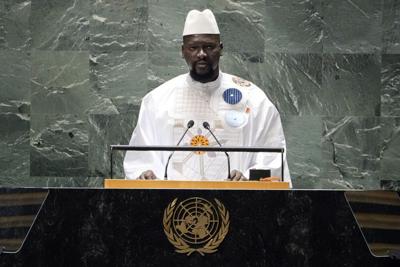
FILE - Guinea's President Mamadi Doumbouya addresses the 78th session of the United Nations General Assembly, on Sept. 21, 2023. (AP Photo/Richard Drew, File)
FILE - Guinea's President Mamadi Doumbouya addresses the 78th session of the United Nations General Assembly, on Sept. 21, 2023. (AP Photo/Richard Drew, File)
CONAKRY, Guinea (AP) — Parts of Guinea's capital have been on lockdown as civil society and opposition groups in the West African nation protested the ruling junta’s missed deadline to launch a return to democracy, with the U.S. calling for clear timelines to hold long-delayed elections.
Meanwhile, a court jailed opposition leader Aliou Bah for two years after he was charged with “insulting� the junta leader following his arrest in December.
Guinea is one of where the military has taken power and delayed a return to civilian rule. Col. Mamadi Doumbouya, in power since 2021, to launch a democratic transition after a Dec. 31, 2024, deadline.
However, the passing of that deadline came with more promises. In his New Year's message, Doumbouya said a decree for a constitutional referendum will be signed to launch the democratic process, without committing to a date. Activists and opposition groups condemned the announcement as a ploy to prolong military rule.
The U.S. State Department urged the military leaders to commit to concrete steps for the constitutional referendum and democratic elections, and to involve civil society groups and political parties in the process.
“The United States is concerned that Guinea has not met its January 1, 2025, target date to launch its democratic transition and calls on the Guinean government to undertake a transparent and inclusive process that engages all Guineans,� it said in a statement Monday.
Beyond scheduling elections, there are concerns about the credibility of elections. The junta dissolved more than 50 political parties last year in a move it claimed was to “clean up the political chessboard.�
The junta has also on independent media, rights groups say, with social networks and private radio stations often cut off, information sites interrupted or suspended for several months without explanation, while journalists face attacks and arrests.