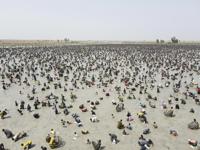
SAN, Mali (AP) — Thousands of fishermen holding cone-shaped nets stood side by side, cheering and chanting as they waited for the signal. Suddenly, they rushed to a large muddy pond and cast their nets, dropping to their knees in the mud. Soon, one proudly held up a fish the length of his arm.
The marathon session of collective fishing celebrates the town's founding and marks the beginning of the rainy season. But and heat waves are disturbing the tradition.
Heat waves in Mali in recent years have caused the pond to start drying out. Temperatures in the town have reached a record this year at 48.5 degrees Celsius (119 degrees Fahrenheit), Emmanuel Doumbia, a local weather observer, told The Associated Press.
The this year has also led to a surge in deaths. The heat wave began in March as many in the Muslim-majority country observed the Islamic holy month of Ramadan with dawn-to-dusk fasting.
The Red Cross Red Crescent Climate Center said that insufficient data in Mali makes it impossible to know the number of heat-related deaths, but estimated that the toll this year has likely been in the hundreds, if not thousands.
An analysis published in April by the World Weather Attribution — an international team of scientists looking at how human-induced climate change impacts extreme weather — said the latest heat wave in the Sahel, a region south of the Sahara that suffers from periodic droughts, is more than just a record-breaker.
Climate change has made maximum temperatures in Burkina Faso and Mali hotter by 1.5 degrees Celsius (2.7 degrees Fahrenheit), the researchers said.
Experts have warned of more scorching weather ahead.
“This tradition was already established before I was born,� said one participant, Amadou Coulibaly, who remains faithful to it despite the growing challenges.