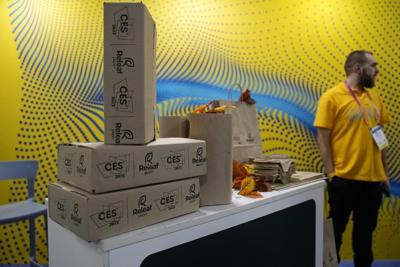
Packaging made from leaves is on display at the Releaf Paper booth during the CES tech show Thursday, Jan. 5, 2023, in Las Vegas. (AP Photo/John Locher)
Packaging made from leaves is on display at the Releaf Paper booth during the CES tech show Thursday, Jan. 5, 2023, in Las Vegas. (AP Photo/John Locher)
LAS VEGAS (AP) 鈥� The past year has been difficult for startups everywhere, but running a company in Ukraine during the Russian invasion comes with a whole different set of challenges.
Clinical psychologist Ivan Osadchyy brought his medical device, called Knopka, to this year's CES show in Las Vegas in hopes of getting it into U.S. hospitals.
His is one of a dozen Ukrainian startups backed by a government fund that are at CES this year to show their technology to the world.
鈥淭wo of our hospitals we operated before are ruined already and one is still occupied. So this is the biggest challenge,鈥� Osadchyy said.
鈥淭he second challenge is for production and our team because they are shelling our electricity system and people are hard to work without lights, without heating in their flats," he said.
He came up with the device after spending a year with his own grandmother in the hospital and finding that he had to track down nurses when she needed something.
The system works by notifying nurses when a patient has an abnormal heart rate, is due for treatment or otherwise needs help. The nurse can鈥檛 turn off their button until they鈥檝e dealt with the issue.
"We are still working and operating because hospitals are open and we need to support them and provide efficiency and safety for patients as well,鈥� he said.
Karina Kudriavtseva of the government-backed Ukrainian Startup Fund, says that, like Knopka, all of the country's startups have kept going since Russia鈥檚 invasion almost a year ago.
鈥淭he times have changed, their conditions have changed, but it can only make them stronger because all of the startups are working on the thing that to save the company, save the team, save the business, and save their lives, of course," she said.
The invasion forced Valentyn Frechka to relocate to France, but he says his Releaf paper company has never stopped production.
When he was 16, Frechka decided to study alternative sources of cellulose in order to decrease deforestation. He鈥檚 now developed a technology that uses fallen leaves and recycled fibre to make paper.
The company's main product is paper shopping bags, but they also make food packaging, egg trays and corrugated boxes.
Frechka says the conflict has forced the company to become more flexible and more open to opportunities.
鈥淲hen this conflict happened and we located our company to France, we have found a lot of new partners and we have raised fundraising. We have raised the money for our needs,鈥� he says. 鈥淪o it really makes us more open for the world.鈥�
___
For more coverage of the Consumer Electronics show, visit: