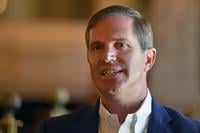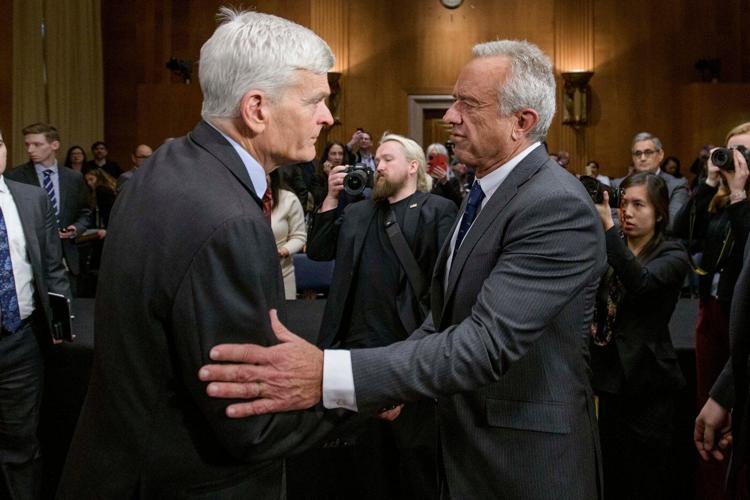
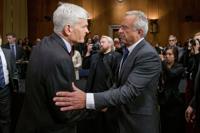
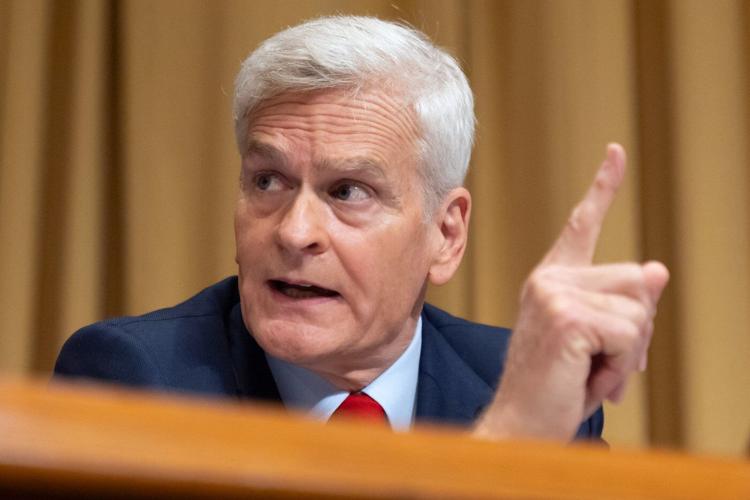
Bill Cassidy鈥檚 roles as a lawmaker, a doctor and a political candidate are colliding on Wednesday as he questions Health Secretary Robert F. Kennedy Jr. in two high-stakes Senate hearings.
The Louisiana Republican chairs one of the Senate committees that oversees Kennedy's department and sits on another, giving him two chances to interrogate the secretary about his plans for an agency responsible for public health programs and research. As a doctor, even though he provided crucial support for the health secretary's nomination last year.
At the same time, Cassidy is fighting for his political future in next month鈥檚 primary in Louisiana, where President Donald Trump has in an unusual attempt to oust a sitting senator from his own party.
How Cassidy handles the hearings could affect his chances at a pivotal moment of his reelection campaign and set the tone for how Congress oversees the nation's health agenda at a time of rampant distrust and misinformation.
鈥淗e鈥檚 taken a risk showing any sort of resistance to RFK,鈥� said Claire Leavitt, an assistant professor at Smith College who studies congressional oversight. 鈥淗e may pay an electoral price for that.鈥�
Cassidy hasn't faced Kennedy in public since September. In the subsequent months, Kennedy has attempted that, if not blocked by , could undermine protections against diseases like flu, hepatitis B and RSV.
After a backlash, Kennedy has also pivoted to spending more time talking about less controversial topics like healthy eating 鈥� albeit with his own spin, including sharing exaggerated claims that various ailments can be .
Cassidy will have to decide on Wednesday whether to grill Kennedy on vaccines, an issue deeply important to him, or put their differences aside and prioritize loyalty to the Trump administration.
In his first opportunity to question Kennedy on Wednesday morning, Cassidy didn't bring up vaccines at all. Instead, he focused on health care affordability and rooting out fraud in federal health care systems, both of which have been priorities for him in Congress.
Cassidy has long advocated for vaccines
Cassidy has spent years walking a political tightrope. He's one of the few Republican senators who voted to convict Trump during after the Jan. 6, 2021, attack on the U.S. Capitol.
As a liver doctor, he advocated for babies to receive hepatitis B vaccines shortly after birth, a step that could have prevented the disease in his patients. But when Trump nominated Kennedy, a longtime anti-vaccine activist, Cassidy supported him. He did so after securing various commitments, including that Kennedy would work within the current vaccine approval and safety monitoring system and support the childhood vaccine schedule.
The vote for Kennedy did not appear to mollify Trump. The president , one of Cassidy's two primary opponents.
Cassidy also faces opposition from Kennedy's allies in the 鈥淢ake America Healthy Again鈥� movement, a group that includes both anti-vaccine activists and a wide variety of other crusaders for health and the environment. The MAHA PAC, aligned with Kennedy, has pledged $1 million to Letlow鈥檚 campaign. While the organization hasn't publicly said so, some have questioned whether the support is partly in retaliation against Cassidy for criticizing Kennedy's vaccine policy agenda.
鈥淚鈥檓 not really sure what MAHA鈥檚 beef is," Cassidy told reporters earlier this month. 鈥淟et me point out that I am the reason that Robert F. Kennedy is now the secretary of HHS. He would not have gotten there otherwise."
Cassidy argues that he has 鈥渟trongly supported鈥� the MAHA agenda, especially when it comes to the fight against ultraprocessed foods. However, the physician-turned-senator acknowledged that he and MAHA have 鈥渄isagreed on vaccines."
鈥淲e鈥檝e seen, frankly, that I am right," Cassidy added, pointing to recent of children who were not vaccinated.
At , he slammed Kennedy鈥檚 decision to slash funding for mRNA vaccine development. He interrogated Kennedy over his attempt to replace members of a vaccine committee, suggesting the new members could have conflicts of interest. He also raised concerns that Kennedy's vaccine policy decisions could be making it harder for Americans to get COVID-19 shots.
Later that month, Cassidy featuring former U.S. Centers for Disease Control and Prevention Director Susan Monarez, who was ousted by Kennedy less than a month into her tenure after they clashed over vaccine policy, and former CDC Chief Medical Officer Debra Houry, who resigned in August citing an erosion of science at the agency.
鈥淚 want to work with the president to fulfill his campaign promise to reform the CDC and Make America Healthy Again. The president says radical transparency is the way to do that,鈥� Cassidy said at the time.
Experts say Cassidy's vaccine stance might not hurt him
Political consultants said they expect Cassidy鈥檚 primary opponents, Letlow and Louisiana Treasurer John Fleming, to seize on any sound bites from Wednesday鈥檚 hearings that can make Cassidy seem at odds with the Trump administration.
But Dorit Reiss, a vaccine law expert at UC Law San Francisco, said the political risk of advocating for vaccines may not be as strong among Republicans as some people assume.
鈥淗e鈥檚 probably not alienating voters by focusing on the issue and calling it out,鈥� she said.
Louisiana political consultant Mary-Patricia Wray said she thinks most diehard MAHA voters already know who they are voting for, and it鈥檚 probably not Cassidy.
Instead, she said, he may still be able to appeal to Democrats who switch their party registration to vote in the primary, as well as a wide swath of still-undecided Republican voters who care about the same health care affordability issues he advocates for every day in Congress.
鈥淚f I was advising Bill Cassidy, I would tell him your goal here is not to get out unscathed,鈥� Wray said. 鈥淵our goal is to prove that your consistency on issues regarding public health is an asset in your campaign, not a detriment.鈥�
Election outcome will shape future oversight of HHS
Also at stake if Cassidy doesn鈥檛 make it to November鈥檚 general election is what will happen to his responsibility to oversee the massive U.S. Department of Health and Human Services as the chair of the Senate Health, Education, Labor and Pensions committee.
Leavitt, the Smith College professor, said seniority typically plays the most important role in who chairs Senate committees. She said another Republican in today鈥檚 increasingly hyperpartisan Congress may not be as willing as Cassidy to check Kennedy鈥檚 power.
Reiss, the vaccine law expert, said she wishes Cassidy had done more hearings or introduced legislation to rein in Kennedy. And she said the senator bears the blame for allowing Kennedy to bring unfounded vaccine fears into the government in the first place.
鈥淗is original sin, of course, was voting for Kennedy at all,鈥� Reiss said.
___
Associated Press writer Sara Cline contributed to this report.