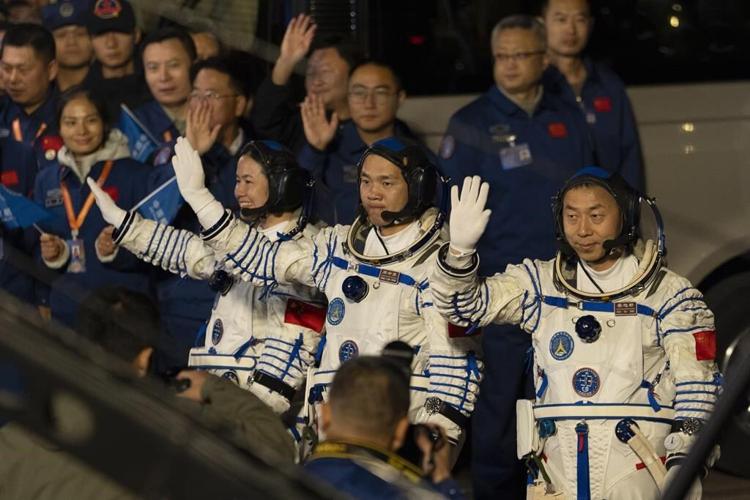
Chinese astronauts Wang Haoze, from left, Song Lingdong and Cai Xuzhe wave during the see-off ceremony for the Shenzhou-19 mission at the Jiuquan Satellite Launch Center in northwestern China, in the early hours of Wednesday, Oct. 30, 2024. (AP Photo/Ng Han Guan)
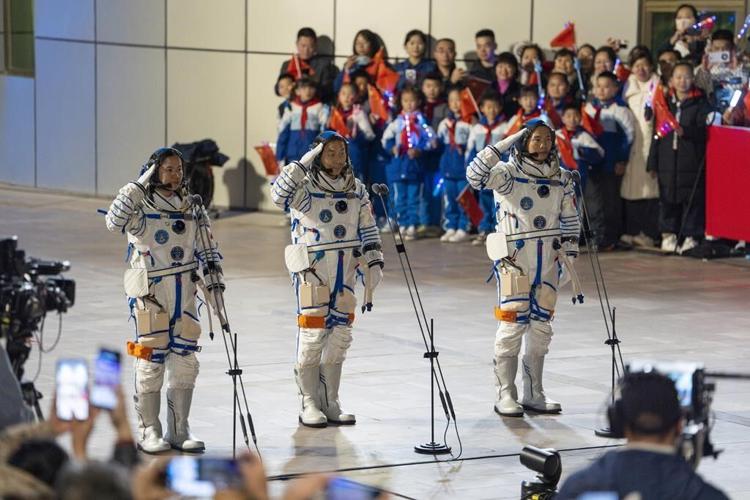
Chinese astronauts Wang Haoze, from left, Song Lingdong and Cai Xuzhe wave during the see-off ceremony for the Shenzhou-19 mission at the Jiuquan Satellite Launch Center in northwestern China, in the early hours of Wednesday, Oct. 30, 2024. (AP Photo/Ng Han Guan)
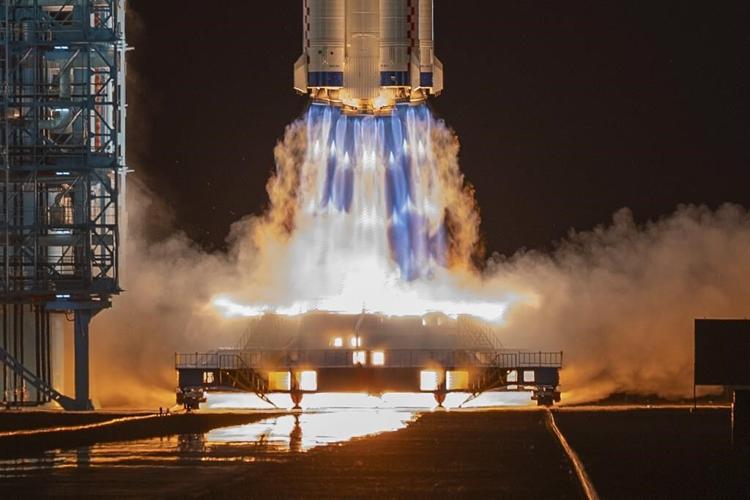
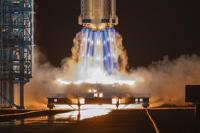
Shenzhou-19 spacecraft sitting atop a Long March rocket takes off from the Jiuquan Satellite Launch Center in Jiuquan, northwestern China in the early hours, Wednesday, Oct. 30, 2024. (AP Photo/Ng Han Guan)
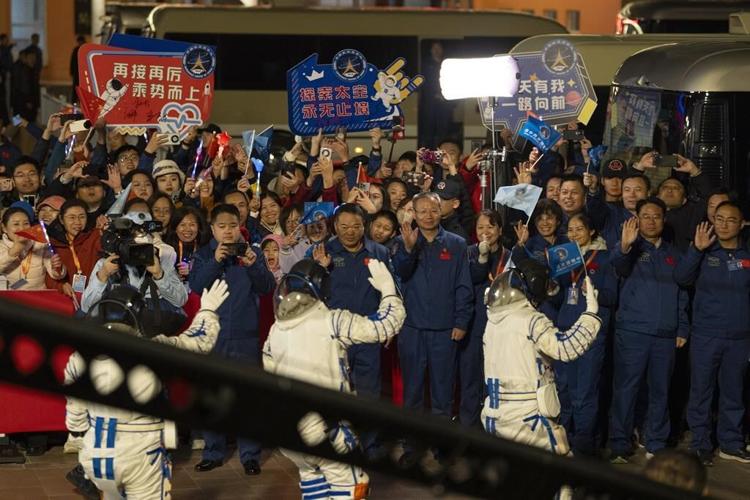
Chinese astronauts Wang Haoze, from left, Cai Xuzhe and Song Lingdong salute as they attend the see-off ceremony for the Shenzhou-19 mission at the Jiuquan Satellite Launch Center in northwestern China, in the early hours of Wednesday, Oct. 30, 2024. (AP Photo/Ng Han Guan)
Chinese astronauts Wang Haoze, from left, Song Lingdong and Cai Xuzhe wave during the see-off ceremony for the Shenzhou-19 mission at the Jiuquan Satellite Launch Center in northwestern China, in the early hours of Wednesday, Oct. 30, 2024. (AP Photo/Ng Han Guan)
NHG
Chinese astronauts Wang Haoze, from left, Song Lingdong and Cai Xuzhe wave during the see-off ceremony for the Shenzhou-19 mission at the Jiuquan Satellite Launch Center in northwestern China, in the early hours of Wednesday, Oct. 30, 2024. (AP Photo/Ng Han Guan)
NHG
Shenzhou-19 spacecraft sitting atop a Long March rocket takes off from the Jiuquan Satellite Launch Center in Jiuquan, northwestern China in the early hours, Wednesday, Oct. 30, 2024. (AP Photo/Ng Han Guan)
NHG
Chinese astronauts Wang Haoze, from left, Cai Xuzhe and Song Lingdong salute as they attend the see-off ceremony for the Shenzhou-19 mission at the Jiuquan Satellite Launch Center in northwestern China, in the early hours of Wednesday, Oct. 30, 2024. (AP Photo/Ng Han Guan)
JIUQUAN, China (AP) 鈥� A Chinese space ship carrying a three-person crew docked with its orbiting space station Tuesday as the country seeks to expand its exploration of outer space in competition with the United States, even as it looks for cooperation from other nations.
The team of two men and one woman will replace the astronauts who have lived on the Tiangong space station for the last six months, conducting a variety of experiments and maintaining the structure.
They are expected to stay until April or May of next year. The new mission commander, Cai Xuzhe, went to space in the Shenzhou-14 mission in 2022, while the the other two, Song Lingdong and Wang Haoze, are first-time space travelers. Song and Wang were born in the 1990s and are graduates of the third wave of Chinese astronaut recruitment, having undergone a rigorous testing and training process taking years.
Early Wednesday morning, China declared the launch and entry into outerspace a 鈥渃omplete success.鈥�
The Shenzhou-19 spaceship carrying the trio blasted off from the Jiuquan Satellite Launch Center in northwest China at 4:27 a.m. local time atop a Long March-2F rocket, the backbone of China鈥檚 crewed space missions.
鈥淭he crew condition is good and the launch has been successful,鈥� the state broadcaster China Central Television announced.
China built its after being excluded from the International Space Station, mainly because of U.S. concerns over the People鈥檚 Liberation Army, the Chinese Communist Party鈥檚 military arm鈥檚 overall control over the space program. China鈥檚 moon program is part of a growing rivalry with the U.S. and others, including and India.
The new team will replace the astronauts who have lived on the Tiangong space station for the last six months and will overlap with them for a couple of days or more. They are expected to stay until April or May of next year.
The new mission commander, Cai Xuzhe, went to space in the Shenzhou-14 mission in 2022, while the other two, Song Lingdong and Wang Haoze, are first-time space travelers, born in the 1990s.
Song was an air force pilot and Wang an engineer with the China Aerospace 国产诱惑福利 and Technology Corporation. Wang will be the crew鈥檚 payload specialist and the third Chinese woman aboard a crewed mission.
Besides putting a space station into orbit, the Chinese space agency has . It aims before 2030, which would make China the second nation after the United States to do so. It also plans to build a research station on the moon and has already transferred rock and soil samples from the moon in a first for any nation in decades, and placed a rover on the little-explored far side of the moon in a global first.
The U.S. still leads in space exploration and plans to land astronauts on the moon for the first time in more than 50 years, though NASA to 2026 earlier this year.
The new Chinese crew will perform spacewalks and install new equipment to protect the station from space debris, some of which was created by China.
According to NASA, large pieces of debris have been created by 鈥渟atellite explosions and collisions.鈥� China鈥檚 firing of a rocket to destroy a redundant weather satellite in 2007 and the 鈥渁ccidental collision of American and Russian communications satellites in 2009 greatly increased the amount of large debris in orbit,鈥� it said.
China鈥檚 space authorities say they have measures in place in case their astronauts have to return to Earth earlier.
China launched its first crewed mission in 2003, becoming only the third nation to do so after the former Soviet Union and the United States. The space program is a source of enormous national pride and a hallmark of China鈥檚 technological advances over the past two decades.
___
Associated Press producer Caroline Chen contributed to this report.