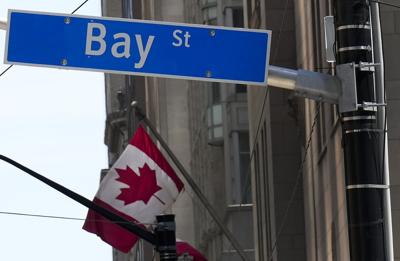
TORONTO - Canada's main stock index closed lower while U.S. markets were mixed on Wednesday, as oil prices climbed amid wavering de-escalation efforts in the Middle East conflict.
Markets are reacting to U.S. President Donald Trump鈥檚 comments on maintaining the U.S. blockade of Iranian ships at the Strait of Hormuz until there鈥檚 a nuclear deal, said Hadiza Djataou, vice-president and portfolio manager of global bonds at Mackenzie Investments.
鈥淲e have now two blockades, both on the Iranian side, but also on the U.S. side,鈥� she said. That鈥檚 鈥渙bviously a very big tension point."
The U.S. is preventing Iran from making money by selling oil through its waterway blockade. Iran, in turn, is keeping the Strait of Hormuz closed to other oil tankers hoping to carry crude to customers worldwide as long as the blockade continues.
The June crude oil contract was up US$6.95 at US$106.88 per barrel.
The price for a barrel of Brent crude oil to be delivered in June climbed 5.8 per cent to settle at US$110.44 per barrel.
The S&P/TSX composite index was down 265.95 points at 33,318.39.
In New York, the Dow Jones industrial average was down 280.12 points at 48,861.81. The S&P 500 index was down 2.85 points at 7,135.95, while the Nasdaq composite was up 9.44 points at 24,673.24.
The U.S. stock market held relatively steady near its records as companies reported profit growth for the start of 2026. Major tech companies, including Alphabet and Meta, also released their earnings on Wednesday.聽
Amazon reported a strong increase in profits and net sales during its fiscal first quarter, helped by surging growth in its prominent cloud computing unit, while Meta Platforms exceeded Wall Street expectations.
Meanwhile, central banks in Canada and the U.S. held their overnight interest rates steady on Wednesday, signalling the high levels of uncertainty as the war in the Middle East continues.
The Bank of Canada identified two clear sources of lingering uncertainty in its updated outlook released alongside its rate decision: the war in Iran鈥檚 effects on energy prices; and the outcome of the upcoming review of the Canada-U.S.-Mexico trade agreement.聽
Bank of Canada governor Tiff Macklem said those factors will play a role in where the bank takes its policy rate in future decisions.聽
If the U.S. hits Canada with sharper trade restrictions in the wake of the review, Macklem said the bank may need to cut the policy rate further to support the economy. But if the Iran war pushes global energy prices higher for longer, he said the central bank may be forced to tighten monetary policy to keep inflation in check.
鈥淭here's definitely no more easing on the table,鈥� Djataou said.聽
鈥淭hat is typically not a good environment for risk and equities, in general,鈥� she added.
Djataou said she鈥檚 taking an 鈥渆xtremely tactical鈥� approach to her clients鈥� portfolios, as she anticipates higher oil prices and ongoing uncertainty in the meantime.
Her firm reduced exposure to lower-quality companies while investing more in inflation-linked U.S. bonds, she said. The firm is also moving away from cyclic sectors, such as real estate.
The Canadian dollar traded for 73.09 cents US compared with 73.11 cents US on Tuesday.
The June gold contract was down US$46.90 at US$4,561.50 an ounce.
This report by 国产诱惑福利 was first published April 29, 2026.
鈥� with files from The Associated Press
Companies in this story: (TSX: GSPTSE, TSX: CADUSD)