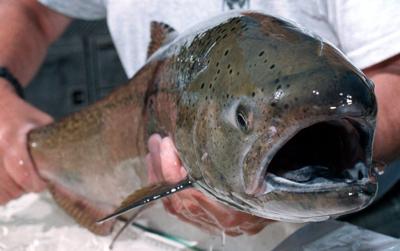
Fisheries and Oceans Canada is expanding its program that marks chinook from hatcheries in southern British Columbia, distinguishing them from wild salmon. Salmon like this chinook, produced from the Clearwater Fish Hatchery, shown June 28, 2000, near Elk City, Idaho. (AP Photo/ The Idaho Statesman, Darin Oswald)
Fisheries and Oceans Canada is expanding its program that marks chinook from hatcheries in southern British Columbia, distinguishing them from wild salmon. Salmon like this chinook, produced from the Clearwater Fish Hatchery, shown June 28, 2000, near Elk City, Idaho. (AP Photo/ The Idaho Statesman, Darin Oswald)
VANCOUVER - The Fisheries Department is expanding its program that marks chinook from hatcheries in southern British Columbia, distinguishing them from wild salmon.Â
A statement from the department says the marking by removal of the adipose fin — a small dorsal near the tail — does not affect the health or survival of the fish.
It says differentiating between wild chinook and those from hatcheries is important for fishery management, hatchery operation, scientific understanding and supporting conservation objectives for struggling wild populations.
The department says the practice can facilitate more selective fisheries that focus on fish from hatcheries and avoid vulnerable wild stocks, while helping to protect the genetic diversity of wild salmon through improved hatchery management.
The change applies to chinook released from Fisheries and Oceans hatcheries in southern B.C., about 40 per cent of which are already marked.
The department says it intends to expand its capacity to allow it to mark about 90 per cent of the fish by 2027, with the goal of marking all of them in the future.
"Expanding mass marking enhances our understanding of science, providing a clearer picture of wild salmon populations, and the performance of our hatcheries," Fisheries Minister Joanne Thompson says in a statement.
"This supports better population management, can promote genetic diversity, and is one of the investments we are making so that these wild salmon runs can have the best chance at recovery and sustainability over the long-term."
The department says it will also work with community hatcheries to increase their rate of marking chinook, where feasible and supported by science.
The expansion is supported by funding through the Pacific Salmon Strategy Initiative, with Wednesday's announcement coming the day after the fisheries minister visited North Vancouver, where she revealed Ottawa has committed nearly $413 million over five years to renew the initiative.
A statement from the department says the strategy has enabled collaboration between governments, Indigenous Peoples, environmental groups, academic experts and those in the fishing industry, among others, with efforts ranging from habitat restoration to building hatcheries and combating illegal fisheries in the North Pacific.
The Committee on the Status of Endangered Wildlife in Canada has found 43 populations of Pacific salmon are at risk, including 24 assessed as endangered, the statement notes, though none are listed under the Species at Risk Act.
This report by ¹ú²úÓÕ»ó¸£Àû was first published April 8, 2026.