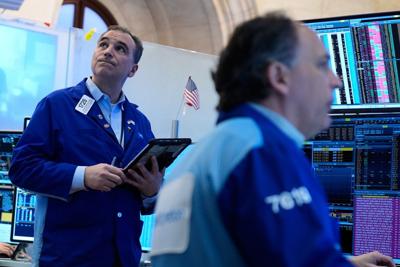
NEW YORK (AP) — Oil prices are down, and stocks are up, though such moves have been quick to change since the war in Iran began. The S&P 500 rose 0.8% early Monday. The index is coming off its third straight losing week, its longest such streak in a year. The Dow Jones Industrial Average rose 364 points, and the Nasdaq composite climbed 1%. The driver for markets once again was the price of oil. A barrel of U.S. crude fell 3.4%, easing some pressure off the economy. Oil prices have been mostly ripping higher since the United States and Israel began their attacks on Iran.
THIS IS A BREAKING NEWS UPDATE. AP’s earlier story follows below.
U.S. markets climbed into positive territory early Monday and the price of oil dipped but remained elevated at around $100 a barrel as the Iran war entered its third week.
Futures for the S&P 500 gained 0.6% while Dow Jones Industrial Average futures rose 0.4%. Nasdaq futures rose 0.8%.
U.S. benchmark crude fell 1.5% to $97.21 per barrel. It's up about 45% since the war began. A barrel of Brent crude, the international standard, ticked up a fraction of a percent to $103.35. It’s climbed more than 40% since the war began.
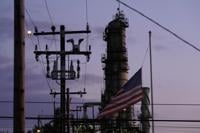
Since being attacked by the United States and Israel more than two weeks ago, has been regularly hitting Israel, American bases and its Gulf Arab neighbors’ energy infrastructure with drones and missiles. It has also retaliated by effectively stopping cargo traffic through the narrow , where a fifth of the world’s oil typically sails. That has oil producers cutting production because their crude has nowhere to go.
In just over a week since the closure of the Strait of Hormuz, more than 12 million barrels of oil equivalent per day have been taken offline, according to independent research firm Rystad Energy.
Only handful of tankers have reportedly passed through the strait.
“The truth is that at this point, much of the market is operating in the fog,� Stephen Innes of SPI Asset Management said in a commentary. “For context, the strait normally handles roughly 25 oil and LNG tankers every single day.�
If the war continues to hamper the production and transportation of oil from the Persian Gulf, it could cause a damaging
Members of the International Energy Agency are from emergency reserves, though it appears to have done little to reassure markets.
In early equities trading Monday, a handful of chip and data storage stocks led the way. Micron, Western Digital, SanDisk and Intel all rose between 3% and 5% before markets opened.
A deal between companies in the business of physical self-storage units was also moving shares. National Storage Affiliates soared 26% in premarket after it announced that it was being bought by Public Storage in an all-stock deal worth about $10.5 billion. Public Storage was down about 3.5% on the news.
At midday in Europe, Germany's DAX edged 0.2% higher while the CAC 40 in Paris was unchanged. Britain's FTSE 100 gained 0.5%.
In Asia, Tokyo's Nikkei 225 edged 0.1% lower to 53,751.15, while the Kospi in South Korea climbed 1.1% to 5,549.85.
Hong Kong's Hang Seng rose 1.5% to 25,834.02 after the Chinese government reported stronger than forecast economic data for February. The Shanghai Composite index shed 0.3%, however, to 4,084.79.
In Australia, the S&P/ASX 200 gave up 0.4% to 8,583.40.
Taiwan's Taiex edged 0.2% lower, while India's Sensex was little changed.
Back in the U.S., higher expectations for inflation complicate the Federal Reserve's efforts to bring interest rates lower to help the economy. The U.S. central bank is not expected to cut rates at its policy meeting this week.
A new snapshot of consumer spending Friday showed that inflation crept higher in January, even before the Iran war caused oil and gas prices to spike.
The Commerce Department reported Friday that consumer compared with a year earlier. But excluding volatile food and energy, core prices rose 3.1%, the highest jump in nearly two years.