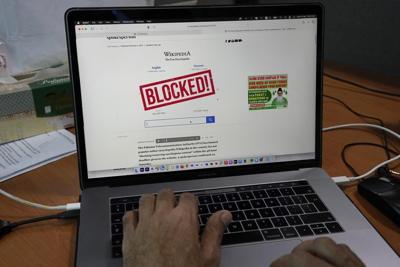
A computer screen displays a notice blocking the Wikipedia website through an online news site in Islamabad, Pakistan, Monday, Feb. 6, 2023. Pakistan's media regulator said Monday it blocked Wikipedia services in the country for hurting Muslim sentiment by not removing allegedly blasphemous content from the site. (AP Photo/Anjum Naveed)
A computer screen displays a notice blocking the Wikipedia website through an online news site in Islamabad, Pakistan, Monday, Feb. 6, 2023. Pakistan's media regulator said Monday it blocked Wikipedia services in the country for hurting Muslim sentiment by not removing allegedly blasphemous content from the site. (AP Photo/Anjum Naveed)
ISLAMABAD (AP) 鈥� Pakistan鈥檚 media regulator said Monday it blocked Wikipedia services in the country for hurting Muslim sentiment by not removing purportedly blasphemous content from the site. Critics denounced Islamabad鈥檚 action, saying it was a blow to digital rights.
Under Pakistan鈥檚 controversial blasphemy laws, anyone found guilty of insulting Islam or its figures can be sentenced to death, although the country has yet to carry out capital punishment for blasphemy.
But even allegations of the offense are often enough to provoke mob violence and even deadly attacks. International and domestic rights groups say that accusations of blasphemy have often been used to intimidate religious minorities and settle personal scores.
The Pakistan Telecommunication Authority says it blocked Wikipedia because a 48-hour deadline to remove the content was ignored, according to a spokesperson. 鈥淪uch things hurt the sentiments of Muslims,鈥� said Malahat Obaid, from the regulator.
She said Pakistani authorities were in talks with Wikipedia officials and the ban could be lifted if the platform completely removes anti-Islam content.
Hours later, Pakistan's Information Minister Marriyum Aurangzeb said that premier Shahbaz Sharif had ordered the immediate restoration of Wikipedia, a move welcomed by Pakistanis.
The Wikimedia Foundation on Saturday confirmed the ban, saying: 鈥淲e hope that the Pakistan government joins us in a commitment to knowledge as a human right and restores access to @Wikipedia and Wikimedia projects promptly, so that the people of Pakistan can continue to receive and share knowledge with the world.鈥�
Mohsin Raza Khan, a Pakistani social media expert, said it is easy to update or replace Wikipedia material deemed sacrilegious or offensive for Muslims 鈥� so blocking the site is not the answer.
鈥淧akistan鈥檚 media regulator and other authorities should try to find some viable technical solution to such problems as blasphemous content is available everywhere,鈥� he said. 鈥淚t is equal to a drop in the ocean of knowledge.鈥�
The Lahore-based Digital Rights Foundation earlier called the Wikipedia ban an affront to Pakistanis鈥� right to access information and a mockery of the country鈥檚 commitment to uphold its human rights obligations.
In the past, Pakistan briefly banned TikTok twice for allegedly uploading 鈥渋mmoral, obscene and vulgar鈥� content.
But the ban was later lifted after TikTok assured Pakistan it would remove immoral content and also block users who upload 鈥渦nlawful content.鈥� The app was downloaded millions of times in Pakistan when the ban was imposed in 2020 and 2021.
Also, in 2008, Pakistan banned YouTube over videos depicting Prophet Muhammad. Muslims generally believe any physical depiction of Islam鈥檚 prophet is blasphemous.
Also on Monday, Amir Mahmood, spokesman for Pakistan鈥檚 Ahmadi community, sought protection from the government, saying unidentified Islamists in multiple separate attacks have damaged Ahmadi places of worship in southern Sindh province and elsewhere in the country.
鈥淭he freedom of worship given to us by the constitution is shrinking,鈥� he told The Associated Press.
The attacks, which took place over several days, caused no casualties, Mahmood said.
The Ahmadi faith was established on the Indian subcontinent in the 19th century by Mirza Ghulam Ahmad, whose followers believe he was the messiah that was promised by the Prophet Muhammad.
Pakistan鈥檚 parliament declared Ahmadis non-Muslims in 1974. Since then, they have repeatedly been targeted by Islamic extremists in the Muslim-majority nation, drawing international condemnation.