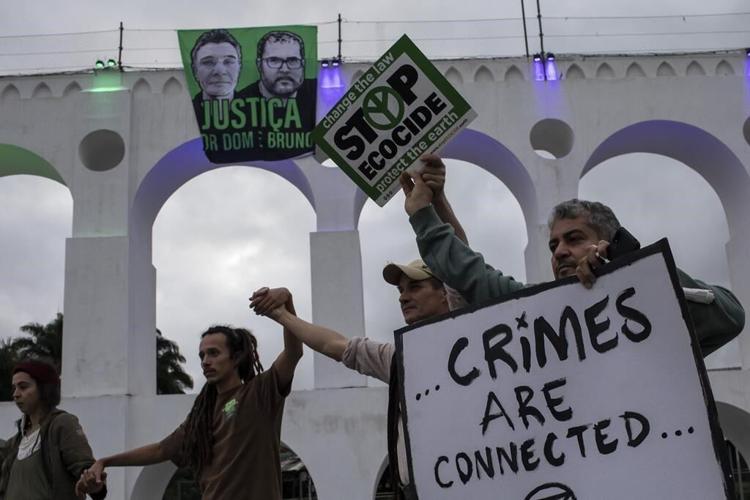
FILE - Social and environmental activists protest for justice in the deaths of British journalist Dom Phillips and Indigenous expert Bruno Pereira at the Arcos da Lapa aqueduct in Rio de Janeiro, Brazil, June 26, 2022. As the one-year anniversary of the murders approached, The Associated Press returned to the Javari Valley to describe the place where the two were killed. (AP Photo/Bruna Prado, File)
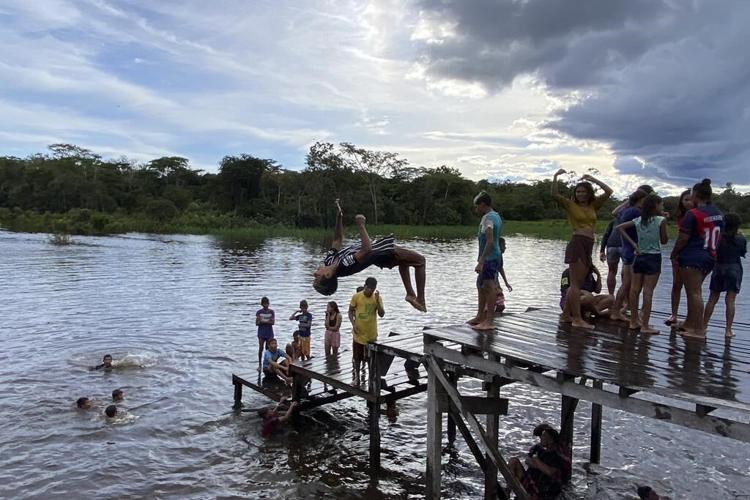
Kids play in Atalaia do Norte, Amazonas state, Brazil, March 1, 2023. As the one-year anniversary of the murders approached, The Associated Press returned to the Javari Valley to describe the backdrop for the loss of the Bruno Pereira and Dom Phillips, an Indigenous advocate and a journalist. (AP Photo/Fabiano Maisonnave)
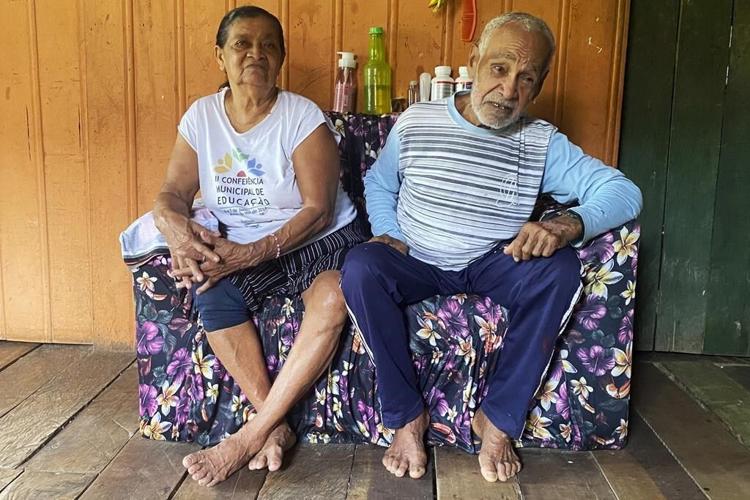
Martins dos Santos, the founder of the Sao Gabriel community sits with his wife, Creuza Tenorio da Silva at home in Atalaia do Norte, Amazonas state, Brazil, Feb. 28, 2023. The community is near where Bruno Pereira, an expert on Indigenous communities, and Dom Phillips, a British journalist, were killed. As the one year anniversary of the murders approached, The Associated Press returned to the Javari Valley to describe the backdrop for the loss of the Indigenous advocate and the journalist. (AP Photo/Fabiano Maisonnave)
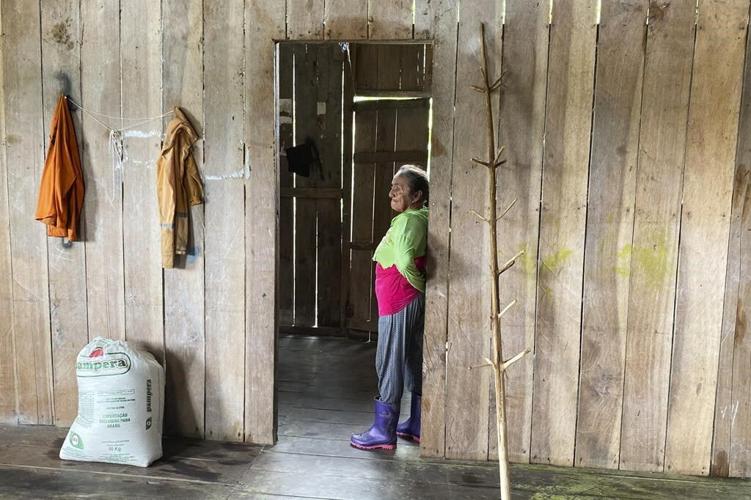
Maria de Fatima da Costa, mother of Amarildo da Costa de Oliveira, who confessed to the killings of Bruno Pereira and Dom Phillips, stands in the doorway of Amarildo's home in the Sao Gabriel community, Amazonas state, Brazil, March 1, 2023. Da Costa is also the mother of Oseney da Costa de Oliveira, also arrested and accused of the murders of Pereira, an expert on Indigenous communities and Phillips, a British journalist. (AP Photo/Fabiano Maisonnave)
FILE - Social and environmental activists protest for justice in the deaths of British journalist Dom Phillips and Indigenous expert Bruno Pereira at the Arcos da Lapa aqueduct in Rio de Janeiro, Brazil, June 26, 2022. As the one-year anniversary of the murders approached, The Associated Press returned to the Javari Valley to describe the place where the two were killed. (AP Photo/Bruna Prado, File)
BP
Kids play in Atalaia do Norte, Amazonas state, Brazil, March 1, 2023. As the one-year anniversary of the murders approached, The Associated Press returned to the Javari Valley to describe the backdrop for the loss of the Bruno Pereira and Dom Phillips, an Indigenous advocate and a journalist. (AP Photo/Fabiano Maisonnave)
Martins dos Santos, the founder of the Sao Gabriel community sits with his wife, Creuza Tenorio da Silva at home in Atalaia do Norte, Amazonas state, Brazil, Feb. 28, 2023. The community is near where Bruno Pereira, an expert on Indigenous communities, and Dom Phillips, a British journalist, were killed. As the one year anniversary of the murders approached, The Associated Press returned to the Javari Valley to describe the backdrop for the loss of the Indigenous advocate and the journalist. (AP Photo/Fabiano Maisonnave)
Maria de Fatima da Costa, mother of Amarildo da Costa de Oliveira, who confessed to the killings of Bruno Pereira and Dom Phillips, stands in the doorway of Amarildo's home in the Sao Gabriel community, Amazonas state, Brazil, March 1, 2023. Da Costa is also the mother of Oseney da Costa de Oliveira, also arrested and accused of the murders of Pereira, an expert on Indigenous communities and Phillips, a British journalist. (AP Photo/Fabiano Maisonnave)
LADARIO, Brazil (AP) 鈥� One year ago on a Friday afternoon, Bruno Pereira, an expert on Indigenous affairs, and Dom Phillips, a British journalist, motored along the Itaquai river in far western Brazil, to the settlement of Ladario. The line of wooden houses here marks a boundary 鈥� between the Javari Valley Indigenous Territory in the Brazilian Amazon, and the non-Indigenous world.
They were greeted by the man everyone knows as Caboclo. Pereira鈥檚 relationship with these river communities had often been tense. He had been the lead official with the nation鈥檚 Indigenous agency, and these non-Indigenous communities were frequent trespassers onto Indigenous land to hunt and fish. He had fought this, confiscating fishing gear.
But Pereira now sought a different approach. He was on leave from the government, helping build alternative livelihoods in these remote and desperately poor communities, which receive virtually no support from the government, although they are entitled to it.
鈥淚 told Bruno that by the end of the month, I would harvest 700 clusters of bananas. He said, 鈥業 will go to Bras铆lia and come back with a solution for you to sell bananas,鈥欌�� Caboclo told The Associated Press.
But Bruno would not return. Within 48 hours he and Phillips would be ambushed and shot, their bodies burned, dismembered and buried in a shallow river grave.
As the one year anniversary of the murders approached, The Associated Press returned to the Javari Valley to describe the backdrop against which the murders took place, and the ripple effects.
Caboclo, who supports five children, did not find a new market for his banana harvest. Instead, the Federal Police accused him of taking part in illegal fishing and took him to a prison run by criminal gangs. Caboclo admits he had fished illegally in the past, but claims he stopped doing so years ago.
He spent 124 days in jail without trial, which his attorney, Mozarth Bessa Neto, said is illegal.
Upstream, the community of S茫o Gabriel is made up of a few wooden houses, five of them empty. There an AP reporter found Maria de F谩tima da Costa, 60, knee-deep in the river, cleaning a wooden plank.
Amarildo da Costa de Oliveira, a fisherman who confessed to the murders and is in prison, is her son. She agrees he must pay for what he did, but tears up recounting that her other son, Oseney da Costa de Oliveira, was also charged in the murders, something he denies. He also has been imprisoned since then.
鈥淗e is innocent. And his house is abandoned, his family is abandoned, everything is falling apart,鈥� she said, with tears in her eyes.
The AP sent inquiries to the Federal Police but did not receive a response.
There is no electricity or plumbing in S茫o Gabriel, even though the government promised things were going to be so different here.
These river communities date back to the rubber era, which began in the late 1800s. The industry鈥檚 decline left thousands of families in poverty across the entire Amazon region.
Many rubber tapper descendants turned to logging, but when Indigenous lands were legally recognized in 2001, they were no longer permitted into those forests.
In 2011, the federal government created a land reform project that on paper, seemed promising: 71,000 hectares of forest (175,000 acres), where traditional, non-Indigenous communities may fish and harvest. It was supposed to bring electricity, rural lines of credit, and assistance for managed fishing and acai growing.
But that didn't happen. In the twelve years since, the National Institute of Colonization and Agrarian Reform, or Incra, allocated just $5,100 for the settlement of five families, it said.
The government鈥檚 absence is so profound here that 81-year-old Martins dos Santos, who actually founded the S茫o Gabriel community, was unaware that he lives in an official settlement until told by the AP.
STATE OF THE CASE
Amarildo da Costa de Oliveira was not the only person to confess to the murders. Another fisherman, Jeferson da Silva Lima, did too, and is also in prison awaiting trial.
Amarildo claims that military police suffocated him with a plastic bag to get his confession. Documents from a medical exam at the time show the two brothers had minor injuries after they were arrested by Amazonas state police. The department did not reply to questions.
A Colombian businessman, Rubens Villar Coelho, stands accused of masterminding the crime, and is also in custody. He financed fishermen who ventured onto Indigenous land on trips that could last weeks.
Some people say the crime also exposed how much Brazil鈥檚 Indigenous agency, Funai, was dismantled under far-right former President Jair Bolsonaro, who long opposed the very concept of Indigenous land rights.
Experiencing that pressure firsthand in his job at Funai, Pereira requested a leave of absence and was working as an advisor for Univaja, an organization that brings together six Indigenous peoples living in the Javari Valley Indigenous Territory, when he was murdered. It is an area roughly the size of Portugal and home to the world鈥檚 largest population of isolated Indigenous groups.
Pereira鈥檚 intention for communities to raise their standard of living through legal activities remains a distant reality now.
Recently a local fishermen鈥檚 association reported that police were using harsh tactics against them and managed to secure free federal legal assistance. The police and other officials 鈥渁re entering homes without a warrant and confiscating fishing gear under the justification that they belong to illegal fishermen. Not all fishermen are criminals, but they are being treated as such,鈥� it said.
____
Associated Press climate and environmental coverage receives support from several private foundations. See more about AP鈥檚 climate initiative . The AP is solely responsible for all content.