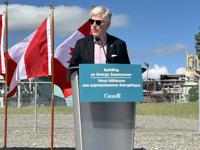
Hydro-Qu茅bec president Michael Sabia speaks at the inauguration of the La Romaine hydroelectric plant, Thursday, Oct. 12, 2023, in Havre St-Pierre, Que. Hydro-Qu茅bec says it plans to spend between $155 billion and $185 billion by 2035 as it looks to increase generating capacity and improve the reliability of its network. THE CANADIAN PRESS/Jacques Boissinot
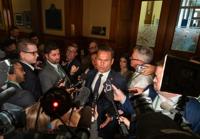
Hydro-Qu茅bec chief executive Michael Sabra holds up a copy of the company plans for the future, Thursday, Nov. 2, 2023, in Montreal. THE CANADIAN PRESS/Ryan Remiorz
Hydro-Qu茅bec president Michael Sabia speaks at the inauguration of the La Romaine hydroelectric plant, Thursday, Oct. 12, 2023, in Havre St-Pierre, Que. Hydro-Qu茅bec says it plans to spend between $155 billion and $185 billion by 2035 as it looks to increase generating capacity and improve the reliability of its network. THE CANADIAN PRESS/Jacques Boissinot
jqb
Hydro-Qu茅bec chief executive Michael Sabra holds up a copy of the company plans for the future, Thursday, Nov. 2, 2023, in Montreal. THE CANADIAN PRESS/Ryan Remiorz
MONTREAL - Quebec's power utility is planning to spend up to $185 billion over the next 12 years to increase capacity and reliability 鈥� and satisfy what it expects will be voracious demand for electricity from industry and electric cars.
The utility anticipates it will see demand rise by between 150 terawatt hours and 200 terawatt hours by 2050, around twice what Quebec consumes now 鈥� with 75 per cent of that increase coming from the replacement of fossil fuels by electricity.
"The plan is an ambitious one but so is the need to decarbonize our economy and invest in economic growth for the future of Quebec," Hydro-Qu茅bec CEO Michael Sabia told reporters Thursday in Montreal after releasing the utility's strategy plan.
Hydro-Qu茅bec said it will invest between $155 billion and $185 billion by 2035 to increase the amount of power it generates and reduce the frequency of outages. About $100 billion of that will go toward boosting production capacity by 60 TWhs 鈥� around 8,500 megawatts 鈥� and strengthening its electricity transportation network.
Sabia estimates that the utility can generate an extra 3,800 megawatts and 4,200 megawatts of power 鈥� "enough to power every home in Montreal" 鈥� by building new hydro stations and by exploiting new technology, such as improved turbines, on existing facilities.
However, the utility 鈥� which generates 99 per cent of its power from hydro plants 鈥� is still considering whether it will build new dams, he said.
"We're in the process of studying several options, and, frankly, it's too early in our process to come to any specific conclusions with regards to (new dams). That said, we're also in the process of having good conversations with several Indigenous communities," he said.
Sabia said Hydro-Qu茅bec wants to evolve from simply compensating Indigenous communities, as it has in the past, toward a partnership model in which projects become a long-term source of revenue for First Nations.
He said he also wants to diversify Hydro-Qu茅bec's energy sources, including by tripling its use of wind power and increasing the use of solar, as well as using renewable natural gas.
Quebec Premier Fran莽ois Legault has touted his vision of turning Quebec 鈥� with its supply of clean electricity 鈥� into the "battery of North America" and has signed major export deals with nearby American states, but Hydro-Qu茅bec has increasingly faced questions about whether it will be able to keep pace with those ambitions.
Absent from the utility's plan is any mention of the Churchill Falls Generating Station, in Labrador. Since 1969, the 5,428-megawatt dam has generated $28 billion for Hydro-Qu茅bec while returning $2 billion to Newfoundland and Labrador. While Legault has said he wants to keep buying from the facility when the current deal expires in 2041, Newfoundland and Labrador Premier Andrew Furey has said Quebec will have to pay more for that privilege.
Sabia told reporters the utility will also spend between $45 billion and $50 billion to improve the reliability of its infrastructure as it looks to reduce the number of outages by 37 per cent over the next seven to 10 years.
Another priority for the Hydro-Qu茅bec is to encourage customers to reduce their electricity use, particularly during peak hours, but Sabia says residential rates 鈥� the lowest in the country 鈥� will not rise beyond three per cent a year.
However, businesses will likely have to pay more.
"There's a large difference between the price of electricity for industry here in Quebec and elsewhere, whether in Canada, in the United States or elsewhere in the world," Sabia said. "This difference is an important element for the competitiveness of our economy, so we will maintain a large difference, but that said, is it possible that there will be an increase in business rates? My answer is yes."
The plan estimates that building the new infrastructure will require around 35,000 construction workers a year 鈥� a number the utility describes as an "enormous challenge" at a time when Quebec faces a labour shortage.
This report by 国产诱惑福利 was first published Nov. 2, 2023.