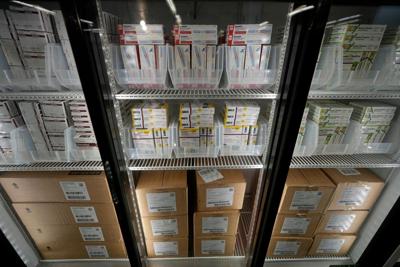

NEW YORK (AP) — Two-year-old Bain Brandon has Type 1 diabetes and needs insulin to live. But even with health insurance, the price tag isn’t cheap.
A one-month supply of insulin vials and a three-month supply of backup pens for the Mississippi toddler cost his parents $194 last week, according to his mom, 29-year-old Marlee Brandon. They can afford it right now — but she worries about the future.
“One day, Bain will be an adult, and he won’t be able to be on our insurance anymore,� she said. “I feel like a lot of people don’t realize how much and how expensive it is.�
A is aiming to relieve that cost burden with the , a bill to cap the cost of the lifesaving drug at $35 per month for Americans with private insurance plans. The bill, introduced last week by Sens. Jeanne Shaheen, D-Maine, Raphael Warnock, D-Ga., Susan Collins, R-Maine, and John Kennedy, R-La., would also start a pilot program to provide more affordable insulin to uninsured Americans in 10 states. A somewhat similar bill passed in 2022, as part of the Biden-era Inflation Reduction Act, a sweeping package from Democrats that successfully for older adults on Medicare.
The legislation, the latest in a long effort by some lawmakers of both parties to , faces many hurdles, including concerns about the cost and other competing congressional priorities. Still, with Trump in the White House and Congress now controlled by his Republican Party, it creates an opportunity for a rare bipartisan victory on health affordability in a year when rising health care cost are a concern for .
Out-of-pocket costs for insulin, a vital drug for millions, vary widely
About 8.1 million people in the U.S. use insulin, according to the U.S. Centers for Disease Control and Prevention. That includes more than 2 million who have Type 1 diabetes and will die without regular access to insulin. The drug also helps control glucose levels for people with other types of diabetes.
But the price of insulin can vary widely. While some people with private insurance pay zero or very little, on top of other costs for their diabetes, like pumps, blood glucose sensors and other supplies.
In addition to the 2022 law lowering out-of-pocket costs on insulin for Medicare beneficiaries, in recent years have passed their own insulin co-pay caps, ranging between $25 and $100 per month for patients with state-regulated insurance plans.
Major insulin makers Eli Lilly, Sanofi and Novo Nordisk also have moved to , with different combinations of cutting list prices, capping out-of-pocket costs and expanding affordability.
Still, not all patients are covered. About 57% of Americans with private health insurance have self-insured plans that states can’t regulate, according to Matthew Fiedler, a senior fellow with the Center on Health Policy at the Brookings Institution. That means they are left out of state cost-cap bills. Some patients are also uninsured, or have difficulty accessing manufacturers' cost savings programs.
“It puts the onus on the patient, I think, to try to navigate and get the cost down,� said Dr. Leslie Eiland, an adult endocrinologist at the University of Nebraska Medical Center, who is advocating with the Endocrine Society for the latest bill.
Oliver Bogillot, Sanofi’s head of general medicines for North America, said in a statement that “no one should struggle to afford their insulin� and touted the company’s savings program that includes people without health insurance. Flavia Brakling, a spokesperson for Novo Nordisk, said expanding affordable access to medicine is a priority and noted the company hasn't raised list prices for its insulin products for 2026.
Chanse Jones, a spokesperson for the leading trade association for pharmaceutical companies, PhRMA, said pharmacy benefit managers and insurers are creating access and affordability barriers for patients even as manufacturers try to expand access.
“We look forward to working with policymakers to ensure middlemen don’t stand between patients and their medicines,� he said.
Efforts to pass similar bills haven't succeeded
While the new INSULIN Act has bipartisan support, it would not be the first time such legislation seemed to have momentum, only to fail.
In 2022, the House passed a $35 monthly insulin cap that would have applied to Americans with private insurance, but it didn’t pass the Senate.
A similar attempt to include it in the Democrats’ Inflation Reduction Act that year ultimately failed after Republicans opposed it, saying it was attempted in a way that violated Senate rules.
Diabetes patients and advocates hold on to hope
Breana Glover, a 23-year-old restaurant server in Houston, moved to Texas from California because she needed cheaper living expenses to cover the high health costs associated with her Type 1 diabetes.
Paying for her insulin and other supplies is a balancing act. To afford her $50 co-pay for four vials of insulin, she limits her carbohydrate intake. That way, she can use less insulin each day and make it last longer.
Glover said a $35 per month cap would be a “small step towards everything becoming even more accessible,� in addition to helping her cover items like groceries and gas.
Advocates expect the young adult population to especially benefit from the bill, since many struggle to get high-quality health insurance plans or any insurance at all if they aren't able to access plans through parents, said Manny Hernandez, CEO of The Diabetes Link, a national nonprofit for young adults with diabetes.
Hernandez said he was encouraged by recent meetings with Republican members of Congress from his home state, Florida, but worries other priorities will drown out the bill, as has happened in the past.
“There’s many distractions and there’s many important things going on,� he said. “But I don’t lose hope.�