It's an enduring stereotype that Canadians are unfailingly nice, quick to apologize even when they have done nothing wrong.
But an online urban legend claims the opposite of Canada's soldiers, painting a picture of troops so brazen in their brutality that international laws were rewritten to rein them in.
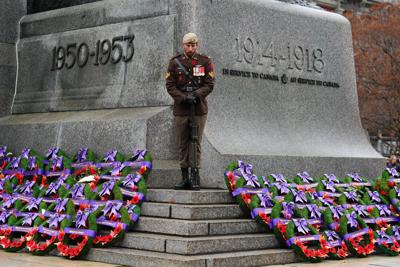
The theory that Canadian soldiers were merciless during the First and Second World Wars and that their behaviour influenced the Geneva Conventions 鈥� international treaties limiting the barbarity of war 鈥� is commonplace online. The fearsome reputation is a point of pride for some, and as nationalism surged last year in the face of U.S. threats, the theory was accentuated.
Google searches for "Canada Geneva Convention" surged in early 2025 and reached their peak last year between Jan. 31 and Feb. 28, which corresponded with the start of the Canada-U.S. trade war. There were subsequent spikes as trade tensions escalated.聽
"Canada is one of the main reasons that the Geneva Convention exists," claims a on Reddit with thousands of "upvotes" signalling users' agreement.
A post with more than 260,000 views said: "The Geneva Convention was actually spawned because of some of the guerrilla warfare that the Canadians would do during war."
"There's a common belief that Canada's extremely harsh treatment of German POWs (prisoners of war) in WW1 inspired the Geneva Convention to completely rewrite war crime laws regarding the treatment of prisoners during warfare," reads the caption of an Instagram with more than 100,000 likes.
CONVENTION PREDATES WORLD WARS聽
Daniel Palmieri, a historian with the International Committee of the Red Cross in Geneva, said the belief that Canadians' battlefield actions affected the Geneva Conventions in any way is false.
"The (first) Geneva Convention, which protected the wounded soldiers on the battlefield, was established in 1864, well before the world wars," he said via email.
The treaty was to clarify the protocols that countries should take with respect to treatment of the wounded during war and was in 1906 with the aim of improving the condition of sick and wounded soldiers.
It was revised again in 1929, to add protocols for the , in response to soldiers' experiences during the First World War.
Prisoners were previously protected under an older convention that didn't address shortcomings revealed by the First World War, such as what to do with long-term captives or the repatriation of prisoners during wartime, Palmieri said.聽
"Attributing this revision of the law to the failings of a particular state is an unfounded argument," he said.聽
Another revision in 1949 saw the incorporation of The Hague Convention to during wars at sea and the adoption of a protecting civilian populations, Palmieri said.
Canada is a signatory to the Geneva Conventions, along with 59 other countries.
IS CANADA'S BATTLEFIELD REPUTATION DESERVED?
The Geneva Conventions legend is often accompanied by an anecdote about Canadian soldiers throwing grenades disguised as canned beef into German trenches during the First World War.
The Canadian war historian Tim Cook, who died last year, documented how both sides engaged in "dirty tricks" during trench warfare. "The Germans were known to booby-trap potential souvenirs in No Man's Land, even attaching explosives to corpses," Cook wrote in his book "Shock Troops: Canadians Fighting the Great War 1917-1918."
In turn, the Canadians "lured in some of the enemy after realizing the Germans liked Allied bully beef. They began to throw over cans of beef into the enemy lines," he wrote. The happy Germans requested more cans and were unprepared when the Canadians lobbed grenades alongside them.
Andrew Burtch, acting chief historian and research director at the Canadian War Museum, said the myth about Canadian soldiers spawning the Geneva Conventions is 鈥渦tter nonsense.鈥�
He said the online claims are driven partly by a nationalistic response to recent Canada-U.S. trade tensions and partly by people misunderstanding Cook's research, which helped shaped many Canadians' understanding of soldiers' conduct during war.聽
Cook looked at soldiers鈥� personal correspondence during the First World War and found references to conduct that might seem harsh, such as showing 鈥渘o mercy鈥� to a prisoner.
鈥淚n this, the Canadians were by no means exceptional,鈥� Burtch said. 鈥淓very combatant in the world wars did something similar."
In "Shock Troops," Cook quoted British infantryman and poet Robert Graves, who wrote that Canadians had "the worst reputation for acts of violence against prisoners." Graves added: "How far this reputation for atrocities was deserved, and how far it could be ascribed to the overseas habit of bragging and leg-pulling, we could not decide. At all events, most overseas men, and some British troops, made atrocities against prisoners a boast, not a confession."
Cook鈥檚 research showed Canadians acquired a fierce reputation for some of their wartime conduct, such as aggressive raids. He also documented instances of brutality toward prisoners of war by Canadian soldiers. However, there were many more instances where Canadians showed care toward the prisoners, Burtch said.聽
The Canadians' fearsome reputation is "partially a cultivated image, and it's something that's a mark of pride for Canadians,鈥� Burtch said. He said misinformation surrounding Canada's military might seem harmless, but there have been instances where rumoured inhumane treatment perpetuated a cycle of violence.聽
For example, one anecdote of Cook's from "The Secret History Of Soldiers: How Canadians Survived The Great War," described a rumour of a Canadian soldier crucified on the battlefield, which the Canadian Corps "often employed as a justification to show no mercy" to the enemy. The British also planted rumours of German battlefield atrocities, which spread among the Canadians.聽
Breaking that cycle is part of what the Geneva Conventions are intended to achieve, Burtch said. "There's a kind of mutual interest in creating conditions whereby people are treated humanely."
He said it's bittersweet to see Cook's research continuing to make waves online. "It really does show the reach that Tim's scholarship has made," he said. But for those who might fall for the "nonsense" of the Geneva Convention myth, his advice is "to read the full story."
厂翱鲍搁颁贰厂鈥�
Claim posted to April 1, 2025 (), March 8, 2025 (), July 1, 2024 ()
Convention for the Amelioration of the Condition of the Wounded in Armies in the Field. Geneva, 22 August 1864. International Committee of the Red Cross International Humanitarian Law Databases . Accessed March 17, 2026 ()
Convention for the Amelioration of the Condition of the Wounded and Sick in Armies in the Field. Geneva, 6 July 1906. International Committee of the Red Cross International Humanitarian Law Databases . Accessed March 17, 2026 ()
Convention relative to the Treatment of Prisoners of War. Geneva, 27 July 1929. International Committee of the Red Cross International Humanitarian Law Databases . Accessed March 17, 2026 ()
Convention (II) for the Amelioration of the Condition of Wounded, Sick and Shipwrecked Members of Armed Forces at Sea. Geneva, 12 August 1949. International Committee of the Red Cross International Humanitarian Law Databases . Accessed March 17, 2026 ()
Convention (IV) relative to the Protection of Civilian Persons in Time of War. Geneva, 12 August 1949. International Committee of the Red Cross International Humanitarian Law Databases . Accessed March 17, 2026 ()
Tim Cook. Shock Troops: Canadians Fighting the Great War, 1917-1918. Viking Canada, 2008.聽
Tim Cook. The Secret History of Soldiers: How Canadians Survived The Great War. Penguin Random House Canada, 2019.聽
ABOUT CANADIAN PRESS FACT CHECKS
You can find out more about 国产诱惑福利 here and about Canadian Press fact checks here. To reach our fact-checking team with any tips, corrections or comments, please email us at cpfactcheck@thecanadianpress.com.