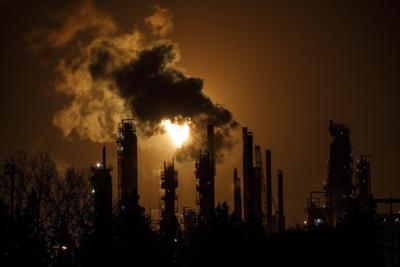
Climate advocacy group Investors for Paris Compliance says attempts to push corporate Canada to reduce emissions have failed to yield the desired results. A refinery in Alberta on Friday, Dec. 28, 2018. LA PRESSE CANADIENNE/Jason Franson
Climate advocacy group Investors for Paris Compliance says attempts to push corporate Canada to reduce emissions have failed to yield the desired results. A refinery in Alberta on Friday, Dec. 28, 2018. LA PRESSE CANADIENNE/Jason Franson
MONTREAL - Attempts to push corporate Canada to reduce emissions have failed to yield the desired results, a climate advocacy group says.
Investors for Paris Compliance, which for the past five years has asked companies to honour their voluntary climate commitments, argued this week that financial market regulators must now step in.
"We鈥檝e come to the conclusion that the results are limited," said Renaud Gignac, a senior adviser with the organization, speaking in French. "It鈥檚 hard to get big companies to budge. There have even been setbacks."
As a result, financial regulators need to take bolder steps, according to a final report from the group on Tuesday, that highlighted a lack of enforcement and transparency around failing to hit voluntary targets.
"We鈥檙e largely limited to climate risk disclosure requirements," Gignac said.
"There are no enforcement measures for these guidelines," he continued. "At least not in a transparent way 鈥� we don鈥檛 see them. There are no penalties for non-compliance."
After a half-decade of shareholder activism that sought to persuade companies to live up to their net-zero pledges, Investors for Paris Compliance is shutting down.
As his swan song with the group, Gignac called for mandatory disclosure of emissions categorized as Scope 3, which refers to all indirect greenhouse gas emissions in a company's value chain 鈥� upstream and downstream.
He would also like to see securities regulators monitor companies more closely on their emissions disclosures, environmental communications and energy transition risks, taking a tougher stand on each.
Like voluntary compliance itself, the environmental role played by financial regulators is a topic that garners little attention. Other measures attract more, such as carbon storage, transport electrification, eco-taxation or changes in consumption habits.
But Gignac says informing investors about the climate risks linked to corporate activities allows shareholders to invest in companies that are better insulated from those risks.
"Capital allocation in the economy could be optimized toward sectors that are less risky 鈥� the sectors of the future 鈥� but the problem is that we don鈥檛 have all the information," he said.
In theory, companies that perform better environmentally would be rewarded in the financial markets.
The profit risk is real for companies. Insurers have been among the first to feel the pain, as weather-related damage becomes more frequent, Gignac noted.
The Insurance Bureau of Canada has said 2024 shattered records as Canadian insurers paid out $8.55 billion for severe weather-related losses 鈥� topping 2016鈥檚 all-time high of $6.2 billion in losses.
鈥淚t鈥檚 a bit like the canary in the coal mine,鈥� said Gignac.
The oil sector 鈥� and the financial institutions that finance it 鈥� also faces an energy transition risk, he added.
鈥淭he Canadian economy is highly exposed, and this exposure isn鈥檛 diminishing as the world moves toward a cleaner economy.鈥�
This report by 国产诱惑福利 was first published June 2, 2026.